
• Skip to primary navigation
  • Skip to main content
  • Skip to footer
Tej Kohli Foundation

Tej Kohli Foundation

Rebuilding People And Communities

  • About
  • Our History
  • Eye Care
    • Tej Kohli & Ruit Foundation
    • Tej Kohli Applied Research
    • Tej Kohli Cornea Institute
    • Tej Kohli Cornea Program
  • Future Bionics
  • Giving
    • Funda Kohli
    • COVID-19 Response
  • News
  • Blog
  • Contact

Resources

IAPB Strategic Framework 2013-2017

April 25, 2015

In September 2013 IAPB approved its new strategic plan 2013-17 at the Council of Members meeting. The new plan was developed in consultation with the membership and is closely aligned to the objectives of the new Global Action Plan for the Prevention of Avoidable Blindness and Visual Impairment 2014-2019 – Towards Universal Eye Health, approved at the World Health Assembly in May 2013.

This strategy is the strategy for the members of IAPB, when acting collaboratively together. It is not a strategy for individual members acting in their own capacity; and it is not a strategy only for the staff employed by IAPB. The term ‘IAPB’, as used in this strategy, refers to the totality of the alliance of members when working together, acting with the support of the staff they employ.
Documents Download

IAPB Strategic Framework 2013-2017

Filed Under: Resources

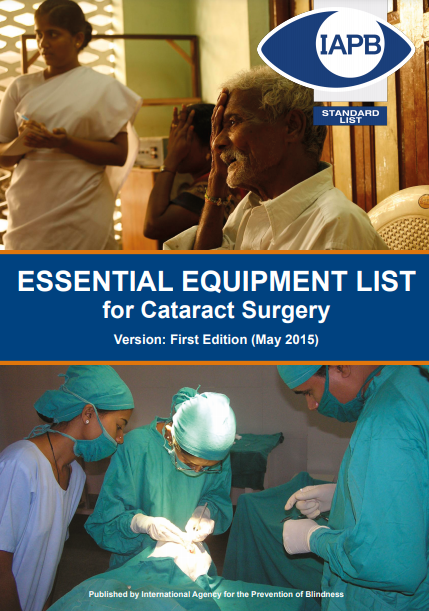
IAPB Essential Equipment List for Trachomatous Trichiasis

April 24, 2015

IAPB consults panels of experts with considerable experience, to identify good practice and assist with the compilation of IAPB Essential Equipment Lists especially for use in in resource constrained settings. NGOs, Ministries of Health, District Health Services, eye clinics and hospitals can use the IAPB Essential Equipment lists to plan and purchase inventory.

Trachoma is the world’s leading cause of preventable blindness, particularly in the most vulnerable populations. Trachoma is estimated to blind one person every 15 minutes. Surgery is one component of the SAFE strategy to address trachoma. The IAPB Essential Equipment for screening and surgery for Trachomatous Trichiasis (TT) list suggests a minimum set of items to perform high quality TT surgery under conditions prevalent in most endemic areas. It reflects the procedures and requirements outlined in the WHO’s Trichiasis Surgery for Trachoma (second edition, 2013) and is aligned with the conclusions and recommendations from the ICTC’s preferred practices Global Scientific Meeting in Trachomatous Trichiasis (2012). This list thus offers suggestions for instruments for alternative surgical procedures: Trabut surgery and two types of Bilamellar Tarsal Rotation (BLTR) Surgery.

Documents Download

IAPB Essential Equipment List for Trachomatous Trichiasis

Filed Under: Resources

IAPB Highlights 2014

April 24, 2015

Annual report on IAPB activities and achievements in 2014.

Documents Download

IAPB Highlights 2014

Filed Under: Resources

IAPB Highlights 2013

April 24, 2015

Annual report on IAPB activities and achievements in 2013.

Documents Download

IAPB Highlights 2013

Filed Under: Resources

Onchocerciasis Advocacy Document

April 15, 2015

For over 40 years, a large global partnership has been battling river blindness (the medical term is onchocerciasis), one of the most devastating of the neglected tropical diseases (NTDs). Huge progress has been made to control the disease; however, it remains among the most prevalent of the NTDs and continues to cause visual impairment, blindness and debilitating skin disease among some of the poorest people on the planet.

This document serves as a framework to address these concerns, identify unique opportunities and alert the international community to the exciting possibility of the elimination of transmission of the disease, but also serves as a wake-up call to the consequences of not continuing the effort. Slowing the momentum would result in disease recurrence, the waste of 40 years of important research, and major stakeholder inputs, creating a major reversal of a public health success.

Documents Download

Onchocerciasis Advocacy Document

Filed Under: Resources

HReH Work Group ToR

March 28, 2015

Having the right people in the right place is the cornerstone to any successful eye health programme. Human resources for eye health (HReH) is a key building block underpinning any health system. Addressing the problem of having too few qualified eye health workers and poor distribution of those qualified health workers is one of the greatest challenges to meeting the goal of Universal Eye Health. In recognition of this IAPB established a committee in 2003 to look into how best IAPB and its members could coordinate efforts to address this problem more effectively.

The HReH committee has recently reviewed its terms of reference and has evolved into a working group with a focussed approach reflecting the areas of human resources development where it is believed it can add value. The new terms of reference are attached here.

The two priority areas the group will be concentrating their efforts around are:

  • Training eye care teams – in collaboration with other stakeholders like the International Council of Ophthalmology (ICO) – “Scaling up numbers”;
  • Advocacy with regions and countries to focus on Human Resource Development for eye health.

The group draws on members from the International Council of Ophthalmology (ICO), World Council of Optometry (WCO), Joint Commission on Allied Health Personnel in Ophthalmology (JCAHPO), the regional HReH work groups, and where required experts in curriculum development and training will be co opted to the group.

Allied Ophthalmic Personnel (AOP) Curriculum

  • Effective practices for eye care team (Case studies)
  • Resources for Allied Ophthalmic Personnel (A list that will be updated regularly)
  • Allied Ophthalmic Personnel Training of trainers curriculum

The “Allied Ophthalmic Personnel Training the Trainers Curriculum” provides resources necessary to educate trainers of AOP to be effective educators. It highlights a list of competencies believed to be important for trainers of AOP.The effective practices for eye care team has case studies from India, Latin America and East Africa. They offer insight into:

  • priority points in the organisation of the eye health workforce
  • systems for training
  • consideration of retaining and providing continuing professional development

Two of the case studies have been provided by IAPB members: LV Prasad Eye Institute and Aravind Eye Care System.

The Resources for Allied Ophthalmic Personnel is a list in progress, to which more additions will be made.

For more information on the HReH Working Group please email us.

Key Documents

Global Human Resource Development Assessment for Comprehensive Eye Care – June 2006

Human Resources for Eye Health Working Group Terms of Reference

Documents Download

HReH Work Group ToR March-2015
Allied Ophthalmic Personnel and Team Training Resources
Allied Ophthalmic Personnel Training the Trainers Curriculum
Effective Practice for Eye Care Team Case Studies
IAPB HRDWG Report – June 2006

Filed Under: Resources

  • « Go to Previous Page
  • Page 1
  • Interim pages omitted …
  • Page 56
  • Page 57
  • Page 58
  • Page 59
  • Page 60
  • Interim pages omitted …
  • Page 73
  • Go to Next Page »
  • Tej Kohli & Ruit Foundation
  • Tej Kohli
  • Contact
  • Our History
  • Eye Care
  • Giving
  • Contact


Copyright © 2026 . Tej Kohli Foundation All Rights Reserved