• Skip to primary navigation
  • Skip to main content
  • Skip to footer
Tej Kohli Foundation

Tej Kohli Foundation

Rebuilding People And Communities

  • About
  • Our History
  • Eye Care
    • Tej Kohli & Ruit Foundation
    • Tej Kohli Applied Research
    • Tej Kohli Cornea Institute
    • Tej Kohli Cornea Program
  • Future Bionics
  • Giving
    • Funda Kohli
    • COVID-19 Response
  • News
  • Blog
  • Contact

Resources

The Emerging Epidemic of Diabetic Retinopathy in India

May 18, 2015

This report provides crucial guidance on how best to tackle what is fast becoming a leading cause of blindness in the Commonwealth and around the world.

Diabetes, which has now reached epidemic levels, brings with it the devastating threat of vision loss and irreversible blindness. Of the estimated 385 million people diagnosed with diabetes globally, over 65
million are in India. This landmark research report details the provisions currently available in India to screen and treat people for diabetic retinopathy, and highlights where improvements are still very much
needed.

Research was conducted across 11 major cities in India, in over 80 eye hospitals or departments, 73 diabetic clinics, and interviews conducted with 650 people with diabetes and diabetic retinopathy.

The research gathered from this study has been used to inform The Queen Elizabeth Diamond Jubilee Trust’s (the Trust) five-year Initiative to tackle blindness caused by diabetes in India. The report’s alarming
finding that almost half of all people with diabetes had already lost vision by the time retinopathy was diagnosed shows that intervention is needed, and quickly.

Documents Download

The Emerging Epidemic of Diabetic Retinopathy in India

Filed Under: Resources

Essential List for Cataract Surgery

May 14, 2015

Cataract remains the major cause of treatable blindness. This IAPB Essential Equipment for Cataract Surgery contains a limited range of adequate supplies of essential items to perform high quality surgery.

IAPB consults panels of experts with considerable experience, to identify good practice and assist with the compilation of IAPB Essential Equipment Lists especially for use in in resource constrained settings. NGOs, Ministries of Health, District Health Services, eye clinics and hospitals can use the IAPB Essential Equipment Lists to plan and purchase inventory.

Documents Download

Essential List for Cataract Surgery

Filed Under: Resources

National Survey of Blindness and VI, Sri Lanka 2014-15

May 9, 2015

Documents Download

National Survey of Blindness and VI, Sri Lanka 2014-15

Filed Under: Resources

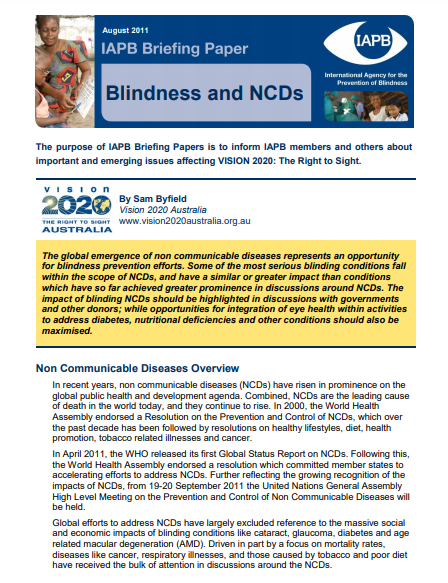
Blindness and Non Communicable Diseases

May 8, 2015

The global emergence of non-communicable diseases (NCDs) represents an opportunity for blindness prevention efforts. Some of the most serious blinding conditions fall within the scope of NCDs and have a similar or greater impact than conditions that have so far achieved greater prominence in discussions around NCDs.

The impact of blinding NCDs should be highlighted in discussions with governments and other donors; while opportunities for integration of eye health within activities to address diabetes, nutritional deficiencies and other conditions should also be maximised.

Documents Download

Blindness and Non Communicable Diseases

Filed Under: Resources

Epidemiology of Blindness in Nepal

May 7, 2015

Nepal is one of the first countries where a nation-wide population-based survey on blindness and visual impairment was done in 1980-81. Results from this survey helped to mobilise support and to build an elaborate eye care infrastructure in the country.

To reassess the situation, between 2006 and 2010 surveys were repeated in all 14 zones of Nepal. This report enables the comparison of the present situation with the findings of the 1981 Nepal Blindness Survey and evaluation of the impact of the eye care system for future planning of eye care services in Nepal.

Documents Download

Epidemiology of Blindness in Nepal

Filed Under: Resources

Inclusion made easy in eye health programs

May 5, 2015

People with disabilities constitute the world’s largest minority group. As such, this ‘guide’ is a very important resource for all people working in eye health. It addresses the specific steps needed to ensure people with disabilities have equal access to eye health programs, and also the need to ensure that those with permanent vision loss access wider opportunities.

This guide seeks to address two important questions facing all eye care personnel, namely:

  • How to make eye care services accessible and inclusive for people with disabilities.
  • How to assist people with permanent vision loss whose sight cannot be restored.

Courtesy of CBM.

Documents Download

Inclusion in Eye Health Guide – CBM

Filed Under: Resources

  • « Go to Previous Page
  • Page 1
  • Interim pages omitted …
  • Page 54
  • Page 55
  • Page 56
  • Page 57
  • Page 58
  • Interim pages omitted …
  • Page 73
  • Go to Next Page »
  • Tej Kohli & Ruit Foundation
  • Tej Kohli
  • Contact
  • Our History
  • Eye Care
  • Giving
  • Contact


Copyright © 2026 . Tej Kohli Foundation All Rights Reserved