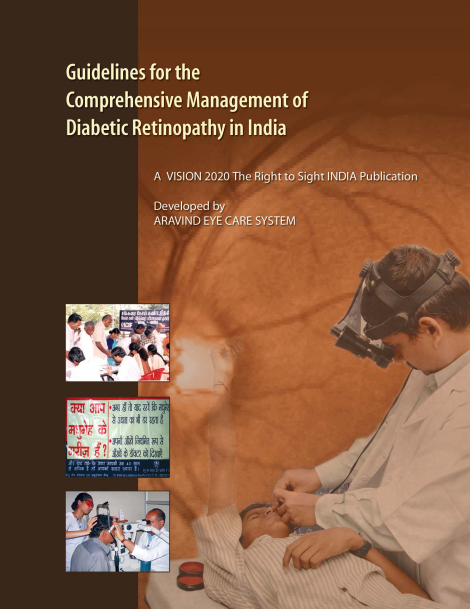
Guidelines for the Comprehensive Management of DR in India

Globally at least 50,000 children are blind from retinopathy of prematurity (ROP) which is now a significant cause of blindness in many middle income countries in Latin American and Eastern Europe. Retinopathy of prematurity is also being reported from the emerging economies of India and China. The characteristics of babies developing severe disease varies, with babies in middle and low income countries having a much wider range of birth weights and gestational ages than is currently the case in industrialized countries. Rates of disease requiring treatment also tend to be higher in middle and low income countries suggesting that babies are being exposed to risk factors which are, to a large extent, being controlled in industrialised countries. The reasons for this “third epidemic” of ROP are discussed as well as strategies for control, including the need for locally relevant, evidence based criteria which ensure that all babies at risk are examined.
Author: Clare Gilbert
Published in:
Early Human Development, Volume 84, Issue 2, February 2008, Pages 77–82
Access the full article at: http://www.sciencedirect.com/science/article/pii/S0378378207002381
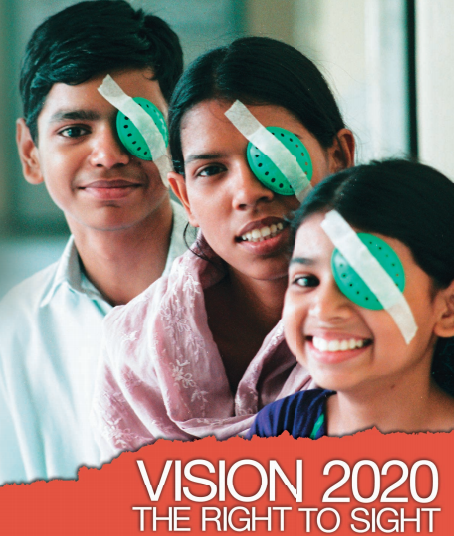
The global initiative known as ‘VISION 2020: the Right to Sight’ is an established partnership between the World Health Organization (WHO) and the International Agency for the Prevention of Blindness (IAPB). It was launched in 1999 with the twin aims of eliminating avoidable blindness by the year 2020 and preventing the projected doubling of avoidable visual impairment between 1990 and 2020.
The ultimate goal of the initiative is to integrate a sustainable, comprehensive, high-quality, equitable eyecare system into strengthened national healthcare systems. In May 2006, the World Health Assembly adopted Resolution WHA 59.25, ‘Prevention of avoidable blindness and visual impairment’, which expanded on the base laid down in an earlier resolution (WHA 56.26) and created a global mandate for VISION 2020.
This document gives eye healthcare providers, policy-makers and VISION 2020 partners an action plan for the activities planned for 2006–2011, although many of the suggestions will be valid well beyond that period. The major base of VISION 2020 activities is at the national level, where monitoring of eye-care services and VISION 2020 activities needs to be improved so that the impact of the interventions on
reducing the prevalence of avoidable visual impairment can be assessed and evaluated periodically.
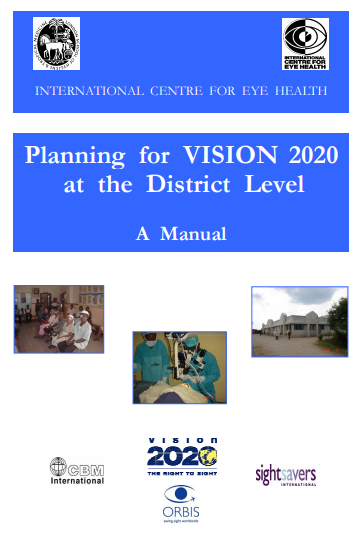
VISION 2020: The Right to Sight was launched by WHO in February 1999. In the intervening years national governments and non-governmental organisations have progressively accepted this initiative as the best approach for improving eye health and preventing blindness.
The realisation of VISION 2020 requires a commitment to develop programmes serving populations at the district level, where needs can be assessed, resources identified and community support motivated. While the need for district planning is clear, the means of bringing this about is more difficult to define.
This manual, published in 2006, is an attempt to document some lessons learnt from three successful but different district models that have been developed in response to local conditions.

Human resources are the most important asset of any health system and their availability and quality are key determinants of efficiency and quality of health services provided. They are crucial to the success and sustainability of all health care provision interventions.
Despite worldwide recognition of its importance, there is a lack of data on the global situation of human resources in eye care. To address this issue, in March 2006 the IAPB Human Resources Development Work Group undertook a global situation analysis on available human resources in comprehensive eye care.
This document was produced following consultations held in Geneva during 1996 and 1997, convened by the WHO Programme for the Prevention of Blindness and Deafness (PBD) at the request of, and with support from, the Task Force of the Partnership Committee of Nongovernmental Development Organizations (An earlier form of IAPB).