
• Skip to primary navigation
  • Skip to main content
  • Skip to footer
Tej Kohli Foundation

Tej Kohli Foundation

Rebuilding People And Communities

  • About
  • Our History
  • Eye Care
    • Tej Kohli & Ruit Foundation
    • Tej Kohli Applied Research
    • Tej Kohli Cornea Institute
    • Tej Kohli Cornea Program
  • Future Bionics
  • Giving
    • Funda Kohli
    • COVID-19 Response
  • News
  • Blog
  • Contact

Resources

Costs of Eye Care Services: Prospective Study from a Faith-based Hospital in Zambia

April 30, 2015

Purpose: 

To estimate the mean costs of cataract surgery and refractive error correction at a faith-based eyehospital in Zambia.

Methods: Out-of-pocket expenses for user fees, drugs and transport were collected from 90 patient interviews; 47 received cataract surgery and 43 refractive error correction. Overhead and diagnosis-specific costs were determined from micro-costing of the hospital. Costs per patient were calculated as the sum of out-of-pocket expenses and hospital costs, excluding user fees to avoid double counting.

Results: 

From the perspective of the hospital, overhead costs amounted to US$31 per consultation and diagnosis-specific costs were US$57 for cataract surgery and US$36 for refractive error correction.

When including out-of-pocket expenses, mean total costs amounted to US$128 (95% confidence interval [CI] US$96–168) per cataract surgery and US$86 (95% CI US$67–118) per refractive error correction. Costs of providing services corresponded well with the user fee levels established by the hospital.

Conclusion: 

This is the first paper to report on the costs of eye care services in an African setting. The methods used could be replicated in other countries and for other types of visual impairments. These estimates are crucial for determining resources needed to meet global goals for elimination of avoidable blindness.”

Documents Download

Costs of Eye Care Services: Prospective Study from a Faith-based Hospital in Zambia

Filed Under: Resources

Gender and Blindness in the Eastern Mediterranean Region

April 29, 2015

As life expectancy increases in countries of the Eastern Mediterranean Region, rates of blindness for women, and overall totals, can be expected to increase. By Women in Health and Development, World Health Organization, Regional Office for the Eastern Mediterranean.

Documents Download

Gender & Blindness WHO_EMR

Filed Under: Resources

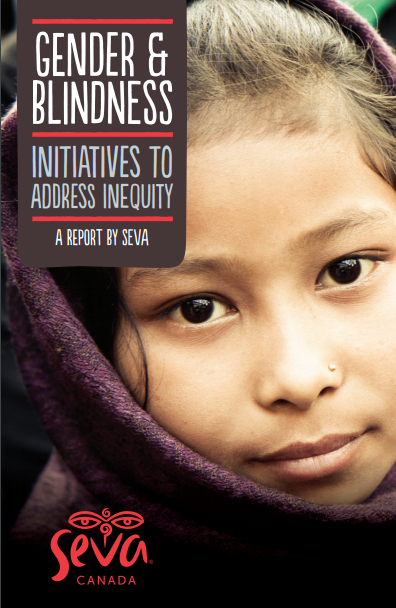
Gender and Blindness: Addressing inequity

April 29, 2015

Globally, two-thirds of all blind people are women, primarily because they are less likely to receive services, compared to men. In many settings, this disparity is even more pronounced between girls and boys.

Seva has taken explicit leadership in the gender and blindness global initiative. All Seva-supported projects work towards achieving gender equity by focusing on overcoming cultural and economic barriers to access by women and girls.

The barriers that prevent women and girls from receiving surgery vary locally and can include:

  • Cost of surgery
  • Inability to travel to a surgical facility
  • Differences in the perceived value of surgery
  • Lack of access to information and resources
  • Fear of a poor outcome

Awareness of the problem is not enough. Political will and social action are needed to address gender inequities in use of eye care services. We believe that in order to achieve the goals of VISION 2020, gender inequities in eye care must be a priority for all organizations.

Courtesy of Seva Canada.

Documents Download

Gender Blindness Report

Filed Under: Resources

Implementing the SAFE Strategy for Trachoma Control

April 29, 2015

The purpose of this manual is to provide program managers and planners with guidance for designing interventions for facial cleanliness (F) and environmental improvement (E) in trachoma control programs.

This manual

  • Shows how to learn about risk practices, identify appropriate F and E interventions, and identify target groups for interventions.
  • Offers a toolbox of F and E interventions with specific examples and case studies.
  • Explains how to communicate about a trachoma control program through the media.
  • Provides steps for evaluating a trachoma control program.
  • Gives resources for further information.

Authors:

Paul Emerson and Laura Frost, with Robin Bailey and David Mabey.

Supported by:

The Conrad N. Hilton Foundation and The Carter Center.

Access full manual at http://trachoma.org/sites/default/files/guidesandmanuals/TrachomaToolboxFinalEnglish.pdf

Filed Under: Resources

How to develop a national advocacy strategy on Human Resources for Eye Health

April 28, 2015

Advocacy is a process of influencing people and institutions in order to achieve a specific outcome. An advocacy campaign is a planned project over a given period of time in order to achieve some specific advocacy goals.

This “How To” guide has been prepared to help you develop an advocacy strategy on Human Resources for Eye Health (HReH). It is particularly focussed on Change Objective #1 of the IAPB Africa HReH strategy: “Every country with a Human Resources for Health (HRH) strategy has an HReH strategy integrated within it”. Therefore, this guide assumes that your country has an HRH strategy or is in the process of developing one.

Documents Download

How to develop a national advocacy strategy on Human Resources for Eye Health

Filed Under: Resources

The Economic Costs of Exclusion and Gains of Inclusion of People with Disabilities

April 27, 2015

With the landmark passing of the United Nations’ Convention on the Rights of Persons with Disabilities (UNCRPD), ratifying countries pledged to promote the full inclusion of people with disabilities in all areas of society.However, many nations have struggled to make significant progress in implementing the commitments set forth by the Convention.

The extensive exclusion of people with disabilities from society is indefensible from a human rights and social justice perspective. However, while this may be widely acknowledged, there is a common perception that inclusive interventions are not financially feasible particularly in the resource-constrained settings of many low and middle income countries (LMICs).

Although the human rights case alone is sufficient to necessitate action, there is also evidence that promoting inclusion of people with disabilities is beneficial from an economic standpoint. Some individual studies have estimated the costs of exclusion and potential gains from inclusion in areas such as work or education, however a comprehensive economics-based argument has not been extensively detailed.

This report seeks to explore the potential pathways through which exclusion of people with disabilities may generate economic costs to individuals, their families and societies at large. Additionally, potential economic gains that may be realised through inclusion are investigated.

Courtesy of CBM and the International Centre for Evidence in Disability.

Documents Download

CBM Costs of Exclusion and Gains of Inclusion Report 2015

Filed Under: Resources

  • « Go to Previous Page
  • Page 1
  • Interim pages omitted …
  • Page 55
  • Page 56
  • Page 57
  • Page 58
  • Page 59
  • Interim pages omitted …
  • Page 73
  • Go to Next Page »
  • Tej Kohli & Ruit Foundation
  • Tej Kohli
  • Contact
  • Our History
  • Eye Care
  • Giving
  • Contact


Copyright © 2026 . Tej Kohli Foundation All Rights Reserved