• Skip to primary navigation
  • Skip to main content
  • Skip to footer
Tej Kohli Foundation

Tej Kohli Foundation

Rebuilding People And Communities

  • About
  • Our History
  • Eye Care
    • Tej Kohli & Ruit Foundation
    • Tej Kohli Applied Research
    • Tej Kohli Cornea Institute
    • Tej Kohli Cornea Program
  • Future Bionics
  • Giving
    • Funda Kohli
    • COVID-19 Response
  • News
  • Blog
  • Contact

Resources

CBM Brazil ROP final evaluation 2014
October 31, 2014

To decrease ROP as a cause of blindness in children in Peru and Brazil with emphasis on Lima and Rio de Janeiro; to demonstrate scalable models which could be adapted for use in other countries of the region and to develop low vision services in both countries, which could be adapted for use in other countries of the region.

Documents Download

CBM Brazil ROP final evaluation 2014

Filed Under: Resources

Perkins China CHEER – The role of education in eye care

October 31, 2014

Perkins International has partnered with organizations around the world to provide support in the education of children with visual impairment and multiple disabilities. This commitment to improving educational services has spanned decades and countless initiatives. In line with Perkins International’s long history of pursuing excellence in blindness education, the Seeing is Believing CHEER Project has sought to increase the educational capacities of a preschool serving children with visual impairments in the Shanxi region of China. This report will detail the findings of this project, focusing on the impact of Perkins International’s trainings on teacher’s skills and behaviors.

Documents Download

Perkins China CHEER – The role of education in eye care

Filed Under: Resources

Position Paper on Recycled Spectacles

October 27, 2014

Each year, Eye Care Non-Governmental Organisations and Institutions are inundated with offers of recycled and used spectacles for the developing world. IAPB recognises the good intentions behind these donations, but advises that its members and other parties engaged in promoting eye health should no longer accept second-hand spectacles.

Documents Download

Position Paper on Recycled Spectacles

Filed Under: Resources

Mapping Human Resources for Eye Health in Sub-Saharan Africa: Progress towards VISION 2020

October 27, 2014

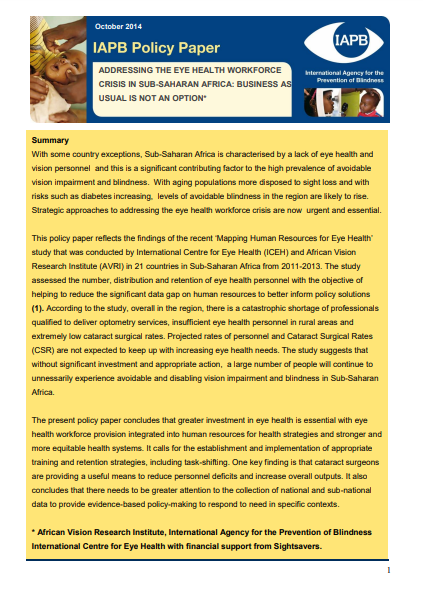
With some country exceptions, Sub-Saharan Africa is characterised by a lack of eye health and vision personnel and this is a significant contributing factor to the high prevalence of avoidable vision impairment and blindness. With ageing populations more disposed to sight loss and with risks such as diabetes increasing, levels of avoidable blindness in the region are likely to rise. Strategic approaches to addressing the eye health workforce crisis are now urgent and essential.

Reflecting the findings of the recent ‘Mapping Human Resources for Eye Health’ study that was conducted by the International Centre for Eye Health (ICEH) and African Vision Research Institute (AVRI) in 21 countries in Sub-Saharan Africa from 2011-2013, this policy paper concludes that greater investment in eye health is essential with eye health workforce provision integrated into human resources for health strategies and stronger and more equitable health systems.

Documents Download

Addressing the Eye Health Workforce Crisis in Sub-Saharan Africa

Filed Under: Resources

Addressing the Eye Health Work Force Crisis in Sub-Saharan Africa

October 17, 2014

With some country exceptions, Sub-Saharan Africa is characterised by a lack of eye health and vision personnel and this is a significant contributing factor to the high prevalence of avoidable vision impairment and blindness. With ageing populations more disposed to sight loss and with risks such as diabetes increasing, levels of avoidable blindness in the region are likely to rise. Strategic approaches to addressing the eye health workforce crisis are now urgent and essential.

Reflecting the findings of the recent ‘Mapping Human Resources for Eye Health’ study that was conducted by the International Centre for Eye Health (ICEH) and African Vision Research Institute (AVRI) in 21 countries in Sub-Saharan Africa from 2011-2013, this policy paper concludes that greater investment in eye health is essential with eye health workforce provision integrated into human resources for health strategies and stronger and more equitable health systems.

Documents Download

Addressing the Eye Health Work Force Crisis in Sub-Saharan Africa

Filed Under: Resources

IAPB Africa Regional Advocacy Strategy 2014-2018

October 17, 2014

In Africa there are an estimated 5.9 million people who are blind and 26.3 million who are visually impaired. This is not a challenge that can be overcome by the NGO sector alone or by “business as usual‟ approaches. It requires a paradigm shift in how eye health services are planned, coordinated and resourced at all levels, ensuring integration with other health systems.

One of the biggest barriers to this transformation and to achieving progress on wider health goals is the critical shortage of health workers. This strategy sets out how IAPB Africa will influence governments and other actors in Africa so that Human Resources for Eye Health (HReH) plans are developed as part of Human Resources for Health (HRH) planning.

This strategy was developed by the IAPB Africa Advocacy Task Team with support from The Pressure Group.

Documents Download

Regional Advocacy Strategy 2014-2018

Filed Under: Resources

  • « Go to Previous Page
  • Page 1
  • Interim pages omitted …
  • Page 58
  • Page 59
  • Page 60
  • Page 61
  • Page 62
  • Interim pages omitted …
  • Page 73
  • Go to Next Page »
  • Tej Kohli & Ruit Foundation
  • Tej Kohli
  • Contact
  • Our History
  • Eye Care
  • Giving
  • Contact


Copyright © 2026 . Tej Kohli Foundation All Rights Reserved