• Skip to primary navigation
  • Skip to main content
  • Skip to footer
Tej Kohli Foundation

Tej Kohli Foundation

Rebuilding People And Communities

  • About
  • Our History
  • Eye Care
    • Tej Kohli & Ruit Foundation
    • Tej Kohli Applied Research
    • Tej Kohli Cornea Institute
    • Tej Kohli Cornea Program
  • Future Bionics
  • Giving
    • Funda Kohli
    • COVID-19 Response
  • News
  • Blog
  • Contact

Resources

Sightsavers Bangladesh Final Evaluation 2015
March 15, 2015

In 2005 – 2008, Sightsavers supported an urban eye care project (Dhaka Urban Eye Care Project – DUECP) implemented by three non-government eye organizations, namely Islamia Eye Hospital as the lead hospital coordinating with the Dhaka Bangladesh National Society for the Blind (BNSB) and the Bangladesh Lions Eye Foundation (BLF), Dhaka.

The successful completion of this project highlighted the need for testing feasibility of a larger demonstration approach that included other key stakeholders like the government, NGO and private sector services. On completion of the pilot project solely supported by Sightsavers till September 2008, the ‘Dhaka Urban Comprehensive Eye Care Project’ (DUCECP)’ was launched with financial support from Standard Chartered’s ‘Seeing is Believing’ (SiB) Phase IV initiative. The DUCECP was designed more comprehensively in the context of the type of eye health services required. The overall budget of the project was USD 1,657,222 spread over a period of 5 years. In 2013, a no-cost extension was agreed for 15 months up to December 2014. Of this, USD 1 million was provided by Seeing is Believing programme, while USD 657,222 was contributed by Sightsavers.

Documents Download

Sightsavers Bangladesh Final Evaluation 2015

Filed Under: Resources

SS India Mumbai final evaluation 2015

January 19, 2015

Eye health is one of the least prioritized public health problems as compared to other health issues globally. As per the estimates by the World Health Organization (WHO), about 285 million people are visually impaired. It clearly states in its’ Global Action Plan (2014-19) that if refractive error services and cataract treatment are provided on priority basis, about two-thirds of the visually impaired population will recover good sight. More than 90 percent of visually impaired people live in developing countries, where the health sector is constrained by lack of affordable and accessible infrastructure.

Vision 2020, a joint programme of the World Health Organization and the International Agency for the Prevention of Blindness (IAPB) with an international membership of NGOs, professional associations, eye care institutions and corporations, clearly advocates the need to improve awareness and strengthen the national programmes on eye health.

Documents Download

SS India Mumbai final evaluation 2015

Filed Under: Resources

WHO Global Action Plan 2014-2019

December 8, 2014

In May 2013 the Sixty-sixth World Health Assembly adopted resolution WHA66.4 entitled ‘Towards universal eye health: a global action plan 2014–2019’. The resolution endorsed the draft action plan for the prevention of avoidable visual impairment for the period 2014–2019, which had been developed by the WHO Secretariat, in close consultation with Member States and international partners, following the request of Member States at the Sixty-fifth World Health Assembly in 2011.

The global action plan 2014–2019 (GAP ) aims to reduce avoidable visual impairment as a global public health problem and to secure access to rehabilitation services for the visually impaired. This should be achieved by expanding current efforts by Member States, the WHO Secretariat and international partners, improved coordination, efficient monitoring, focusing the use of resources towards the most cost-effective interventions, and developing innovative approaches to prevent and cure eye diseases.

The Global Action Plan document, is now available as an Accessible Word document with permission from the World Health Organization.

Documents Download

Universal Eye Health A Global Action Plan 2014-2019
AP2014-19 English Accessible

Filed Under: Resources

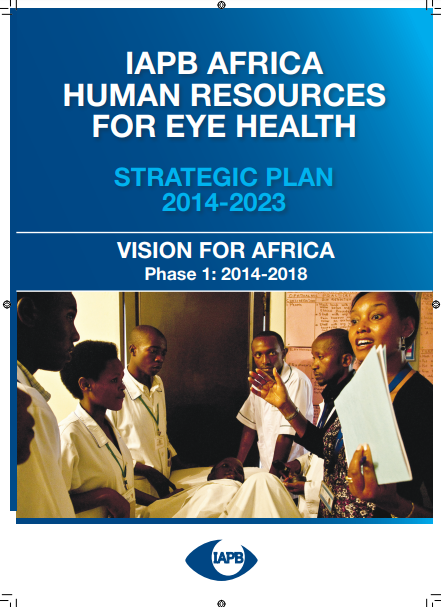
IAPB Africa Human Resources for Eye Health Strategic Plan 2014-2023

November 8, 2014

IAPB Africa comprises over 30 member agencies working in almost every country in South-Saharan Africa (SSA). Our ambition is to influence change in eye health work force planning in SSA by aligning our efforts with health system strengthening and advocating for the full implementation of the 2014-2019 WHO Action Plan for the Prevention of Avoidable Blindness to achieve Universal Coverage.

To achieve our vision we have established a 10 year time frame, divided into two, 5 year, implementation phases and supported by a rolling set of priorities. This strategy lays out our immediate objectives for the first 5 years.

Documents Download

IAPB Africa HReH Strategy

Filed Under: Resources

CBMBrazil Final Evaluation 2014

November 1, 2014

Name of project organization: CBM; Seeing is Believing: collaboration between Standard Chartered Bank and International Agency for Prevention of Blindness (IAPB) Name and title of responsible person: Dr. Andrea Zin

Title of project: “Childhood Blindness in Latin America: Planning and implementing programs for the prevention in children of retinopathy of prematurity. Seeing is Believing. Phase 4. ROP in LA”

Key project partners: Dr. Andrea Zin, Rio de Janeiro, Brazil, Coordinator and Neonatology Department, Instituto Fernandes Figueiras, FIOCRUZ, Rio de Janeiro, Brasil.

Documents Download

CBMBrazil Final Evaluation 2014

Filed Under: Resources

CBM Peru SIB LV final evaluation 2014

November 1, 2014

An evaluation of the low vision (LV) component under the Seeing is Believing supported program in Peru was performed from August 5 -9, 2013 by CBM’s global low vision advisor. The evaluation was to be performed by an expert from Mexico, but due to personal reasons this was cancelled a few weeks before the evaluation was to take place. The CBM advisor has limited Spanish language skills and was thus often dependent on translations.

The main objective of the Seeing is Believing program is to develop appropriate and affordable low vision (LV) service for poor people with low vision in Lima and in 5 provinces.

Documents Download

CBM Peru SIB LV final evaluation 2014

Filed Under: Resources

  • « Go to Previous Page
  • Page 1
  • Interim pages omitted …
  • Page 57
  • Page 58
  • Page 59
  • Page 60
  • Page 61
  • Interim pages omitted …
  • Page 73
  • Go to Next Page »
  • Tej Kohli & Ruit Foundation
  • Tej Kohli
  • Contact
  • Our History
  • Eye Care
  • Giving
  • Contact


Copyright © 2026 . Tej Kohli Foundation All Rights Reserved