• Skip to primary navigation
  • Skip to main content
  • Skip to footer
Tej Kohli Foundation

Tej Kohli Foundation

Rebuilding People And Communities

  • About
  • Our History
  • Eye Care
    • Tej Kohli & Ruit Foundation
    • Tej Kohli Applied Research
    • Tej Kohli Cornea Institute
    • Tej Kohli Cornea Program
  • Future Bionics
  • Giving
    • Funda Kohli
    • COVID-19 Response
  • News
  • Blog
  • Contact

Resources

School Health Programme Advocacy Paper

November 2, 2011

Poor eye health in children is detrimental to all aspects of their development and education and the development of society. However, there are simple solutions for the commonest eye and visual problems.

This IAPB briefing paper outlines how School Health Programmes are already playing a key role in improving the eye health and vision of children and their families but more can be done to make the activities more comprehensive.

Documents Download

School Health Programme Advocacy Paper BP

Filed Under: Resources

A Global Survey of Low Vision Service Provision

June 14, 2011

Purpose:

To conduct a global survey of low vision services to describe the needs, priorities, and barriers in provision and coverage.

Methods:

Data were mainly derived from a survey and from some secondary sources. The survey was distributed to Vision 2020 contacts, government, and non-government organizations (NGOs) in 195 countries during 2006–2008. Themes in the survey were: epidemiology of low vision, policies on low vision, provision of services, human resources, barriers to service delivery, equipment availability, and monitoring and evaluation of service outcomes. Contradictory and/or incomplete data were returned for further clarification and verification. The Human Poverty Index was used to compare the findings from developed and developing countries.

Results:

Service availability was established for 178/195 countries, with 115 having some low vision service. Approximately half the countries in the African and Western Pacific regions have no services. Few countries have >10 low vision health professionals per 10 million of population. In many of the countries NGOs were the main providers and funders. Funding and awareness were frequently cited as barriers to service access. Women, people with disabilities, and rural dwellers were less likely to access services. There were few reports of monitoring and evaluation into the quality and impact of services.

Conclusion:

This global survey provides the first consolidated baseline of low vision service provision. Where data are available, coverage of services is generally poor. Low vision health professional numbers are low. Services in over half of the world’s countries are funded by NGOs, raising issues of sustainability.

Authors:

Peggy Pei-Chia Chiang, Patricia Mary O’Connor, Richard Thomas Le Mesurier, and Jill Elizabeth Keeffe

Published in:

Ophthalmic Epidemiology 2011 Jun;18(3):109-21

Access the full article at http://informahealthcare.com/doi/full/10.3109/09286586.2011.560745

Filed Under: Resources

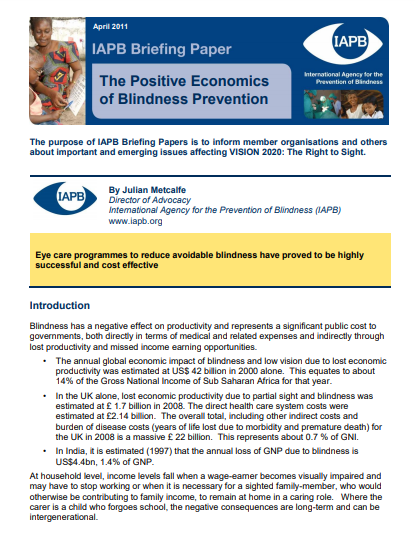
The Positive Economics of Blindness Prevention

April 18, 2011

Eye care programmes to reduce avoidable blindness have proved to be highly successful and cost effective. Blindness has a negative effect on productivity and represents a significant public cost to governments, both directly in terms of medical and related expenses and indirectly through lost productivity and missed income earning opportunities.

Documents Download

The Positive Economics of Blindness Prevention

Filed Under: Resources

Glaucoma

April 11, 2011

Summary:

Most medical practitioners have regular contact with adults who have one of the two forms of glaucoma: open-angle glaucoma or angle-closure glaucoma. Data from population-based surveys indicate that one in 40 adults older than 40 years has glaucoma with loss of visual function, which equates to 60 million people worldwide being affected and 8·4 million being bilaterally blind. Even in developed countries, half of glaucoma cases are undiagnosed. Glaucoma is mostly asymptomatic until late in the disease when visual problems arise. Vision loss from glaucoma cannot be recovered, and improved case-detection methods for glaucoma are needed. Glaucoma is commonly treated with daily eye-drop drugs, but adherence to treatment is often unsatisfactory. As a usually asymptomatic and chronic disease, glaucoma has similar treatment challenges to chronic systemic diseases. Similarities to the pathogenesis of common CNS diseases mean that common neuroprotective strategies might exist. Successful gene therapy, which has been used for other eye diseases might be possible for the treatment of glaucoma in the future.

Author:

Dr Harry A Quigley, MD

Published in:

The Lancet, Volume 377, Issue 9774, 16–22 April 2011, Pages 1367–1377

Access the full article at http://www.sciencedirect.com/science/article/pii/S0140673610614237

Filed Under: Resources

Blindness and the UN Convention on Rights of Persons with Disabilities

March 1, 2011

The UN Convention on Rights of Persons with Disabilities signals a profound shift in international responsibilities towards people with visual impairment.

Documents Download

Positive Economics of Blindness Prevention

Filed Under: Resources

Zithromax® in the Elimination of Blinding Trachoma A Program Manager’s Guide

November 14, 2010

The International Trachoma Initiative (ITI) was founded in 1998 in response to the World Health Organization’s call to eliminate blinding trachoma by the year 2020 (GET2020). ITI’s founding partners, Pfizer and the Edna McConnell Clark Foundation saw the need for an international nongovernmental organization dedicated solely to preventing blinding trachoma.

This manual has been written for use by trachoma program managers and other partners to support and guide the planning, implementation, and evaluation of the antibiotic component of the SAFE strategy.

While antibiotics alone will not eliminate blinding trachoma and sustain its elimination, the generous donation of Zithromax® by Pfizer Inc. is enabling countries to move forward more quickly towards their elimination goals.

Alternative antibiotic therapies are available for endemic countries that are not included in the ITI program. This guide, however, was written especially for Pfizer Inc.’s donation of Zithromax®. The drug donation also allows the global trachoma community to mobilize the additional resources and support necessary for the goal of GET2020 to become a reality.

Published by:

The International Trachoma Initiative, 2010

Access the full guide at http://trachoma.org/sites/default/files/guidesandmanuals/Zithromax%20manager’s%20guide.pdf

Filed Under: Resources

  • « Go to Previous Page
  • Page 1
  • Interim pages omitted …
  • Page 69
  • Page 70
  • Page 71
  • Page 72
  • Page 73
  • Go to Next Page »
  • Tej Kohli & Ruit Foundation
  • Tej Kohli
  • Contact
  • Our History
  • Eye Care
  • Giving
  • Contact


Copyright © 2026 . Tej Kohli Foundation All Rights Reserved