Diabetic Retinopathy
An Overview
Information and resources provided courtesy of The Fred Hollows Foundation (FHF) and IAPB Vision Atlas 2016
Diabetes mellitus is becoming a global epidemic and is now one of the top causes of vision loss globally. In 2014, there were approximately 422 million people (8.5% of the world’s adult population) living with diabetes; compared to 108 million in 1980 (2016 WHO Global Report on Diabetes). Increased urbanisation, consumption of less – nutritious food, more sedentary lifestyles and resulting obesity have all contributed to the dramatic rise in the global prevalence of diabetis, particulrly in resource – poor countries.
Low and middle income countries account for approximately 75% of the global diabetes burden yet many are ill equipped to properly identify, treat and manage the complex and varied consequences of this disease. Currently, South East Asia and the Western Pacific account for more than half of adults with diabetes worldwide. China, India, Indonesia and Bangladesh alone represent 45% of the global burden. Yet the highest prevalence of diabetes is found in the Eastern Mediterranean, where close to 14% of the population is afflicted. Efforts to reduce the prevalence of diabetes or to more effectively manage its health consequences are further undermined by the fact that approximately 50% of people with diabetes are currently undiagnosed. This is even more pronounced in Africa, where two thirds of people with diabetes remain undiagnosed and the greatest increase in disease burden (103%) is anticipated by 2040.
Diabetes increases the risk of a range of eye diseases, but the main cause of blindness associated with diabetes is diabetic retinopathy (DR).
DR damages blood vessels inside the retina at the back of the eye. It commonly affects both eyes and can lead to vision loss if it is not treated. Poorly controlled blood sugars, high blood pressure and high cholesterol increase the risk of developing DR.
Every person with diabetes is at risk of developing DR. Approximately 1 in 3 people living with diabetes have some degree of DR and 1 in 10 will develop a vision threatening form of the disease. DR is the leading cause of vision loss in working age adults (20- 65 years) .
Solutions
People with DR whose sight is at risk can be treated, most commonly with laser, to prevent visual impairment and blindness. However, there is no treatment that can restore vision that has already been lost. Because DR is initially asymptomatic many people with diabetes are not aware that their condition, if left unmanaged it may affect their vision and lead to blindness. The vast majority of patients who develop DR have no symptoms until the very late stages (by which time it may be too late for effective treatment). Therefore screening and early intervention is critical. Targeting resources to the ‘front end’ of the service delivery system over time will help reduce the burden on tertiary services, which are expensive, resource- intensive and often simply unavailable.
There is good evidence, however, that making appropriate lifestyle changes can contain or even reverse the most common form of the disease (Type 2 diabetes). The relevant lifestyle changes involve a sensible lower carbohydrate diet, increased exercise plus control of blood pressure, blood sugar and cholesterol. This is the main primary health care approach that can result in lowering the incidence and ultimately the prevalence of diabetes – but community buy-in is critically important.
Therefore, the most effective diabetic retinopathy programs will take a holistic approach, focusing on patient education, behavior change, and effective disease management strategies in addition to the provision of annual vision exams and high quality, affordable treatment, when required. Increased cooperation between the diabetes care and ophthalmic communities is essential to preventing the impending epidemic of vision loss due to diabetic retinopathy.
Resources
- The International Council of Ophthalmology has issued new Guidelines for Diabetic Eye Care, which are intended to serve a supportive and educational role for ophthalmologists worldwide, with the ultimate goal of improving the quality of eye care for patients with diabetes. Read more…
- Diabetic Eye Health: A Guide for Health Professionals. http://www.idf.org/eyehealth
- The Diabetic Retinopathy Network across low and middle income countries within the Commonwealth (DR-NET) has a collection of DR Resources.
- United Kingdom’s National Institute for Health Research : a comprehensive review of laser treatment for DR. http://www.journalslibrary.nihr.ac.uk/__data/assets/pdf_file/0006/148596/FullReport-hta19510.pdf
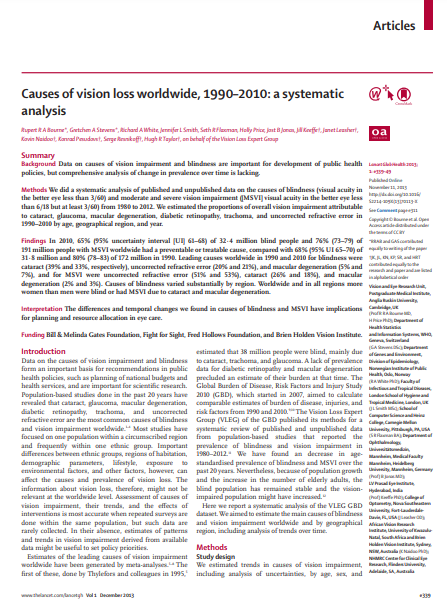
- Global Estimates on the Number of People Blind or Visually Impaired by Diabetic Retinopathy: A Meta-analysis From 1990 to 2010 Diabetes Care Volume 39, September 2016
- DR: ‘Evidence Gap Maps’ : Sightsavers in collaboration with the Cochrane Eyes and Vision Group – http://www.sightsavers.org/gap-maps/diabetic-retinopathy-gap-map/
- The IAPB Essential List for Screening, Monitoring and Treatment for Diabetic Retinopathy http://www.iapb.standardlist.org
- The Online Self Directed Diabetic Retinopathy Grading Course developed by the University of Melbourne School of Population and Global Health and the Center for Eye Research Australia is available in Mandarin and Spanish and will soon be translated into additional languages. The new versions of the course are available at http://drgrading.iehu.unimelb.edu.au.
- The newly formedCommonwealth Eye Health Consortium (consisting of 11 leading research institutions focusing on eye health) which is working to address the growing burden of diabetes across the Commonwealth by supporting a network of hospital-based training links between multiple African and UK eye units focused on building strong diabetic retinopathy teams.” Information regarding theDiabetic Retinopathy LINKS network is available at http://cehc.lshtm.ac.uk/dr-links/
- Community Eye Health Journal (special issue on DR ) http://www.cehjournal.org/
- The Silver Book – Diabetic Retinopathy: Published by The Alliance for Ageing Research http://www.silverbook.org/publication/diabetic-retinopathy/
Download other useful resources and presentations below.
DR Barometer
To improve understanding of the complex global, regional and specific country issues surrounding Diabetic Retinopathy (DR) and Diabetic Macular Edema (DME), the International Federation on Ageing (IFA), the International Agency for the Prevention of Blindness (IAPB) and the International Diabetes Federation (IDF), with support from Bayer, have come together to undertake comprehensive, two-phase, multi-country study known as the DR Barometer Study.
The DR Barometer Study , conducted in 41 countries, shines a spotlight on the prevention, assessment and treatment of diabetic eye disease (DED), as well as the real-life experiences of people living with DED and the perspectives of the clinicians they interact with. A couple of videos by Peter Ackland and Joanna Conlon, IAPB discuss why this is a crucial project.
IAPB Diabetic Retinopathy Work Group
On 6 April 2013, a meeting was organised in Bangkok by The Fred Hollows Foundation and Helen Keller International to bring together NGOs working in DR and coordinate their efforts. The meeting led to the establishment of an IAPB Work Group. Learn more about the group and ways for members to engage at the link below.