• Skip to primary navigation
  • Skip to main content
  • Skip to footer
Tej Kohli Foundation

Tej Kohli Foundation

Rebuilding People And Communities

  • About
  • Our History
  • Eye Care
    • Tej Kohli & Ruit Foundation
    • Tej Kohli Applied Research
    • Tej Kohli Cornea Institute
    • Tej Kohli Cornea Program
  • Future Bionics
  • Giving
    • Funda Kohli
    • COVID-19 Response
  • News
  • Blog
  • Contact

Resources

OEU Ghana Final Evaluation

July 31, 2013

Ghana is a West African country with plains and low plateaus covered in savannah and rainforests. The country has a total landmass of 239,460 square kilometres. From the 2010 national population census, the population of Ghana was estimated at 24,658,823 with a growth rate of 2.3%. The population is currently estimated to be 28,263,513 at the end of 2016. The literacy rate was estimated at 76.6 in 2015 and the poverty rate was estimated at 24.2% in 2013. More than half of the population’s workforce are in farming, mainly small landholders. Due to the differing rainfall patterns, farmers can farm twice a year in the southern and middle belts of the country while farmers in the northern belt can farm only once a year.

Agriculture and the many natural resources of Ghana account for roughly 25% of Gross Domestic Product (GDP). The services sector accounts for 50% of GDP. Gold and cocoa production and individual remittances are major sources of foreign exchange. Oil production at Ghana’s offshore Jubilee field began in mid-December 2010, and drilling of crude oil in other fields commenced afterwards.
Documents Download

OEU Ghana Final Evaluation

Filed Under: Resources

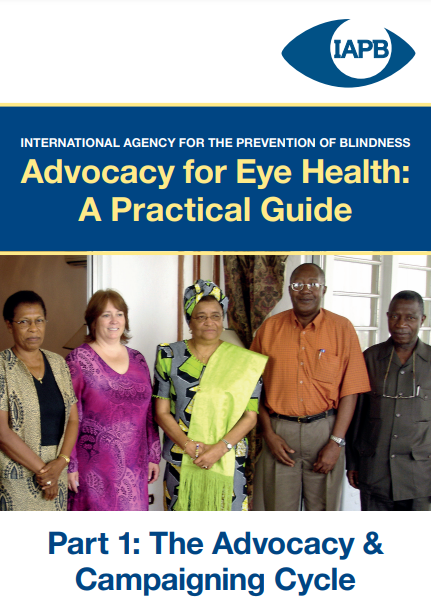
IAPB Advocacy Guide

July 24, 2013

Effective advocacy is critical to the success of international efforts to realise the objectives of VISION 2020: The Right to Sight. Only by securing the support of key actors, whether they are local health providers, national governments, or their development partners, can we hope to bring about the changes we seek: the universal strengthening of eye health services in a sustainable, and equitable, manner.

This guide aims to explain best practice advocacy techniques. It also offers tips on useful tools and provides some real-life examples of successful advocacy in practice.

Documents Download

Advocacy Guide
Advocacy Toolkit
IAPB How to Guide

Filed Under: Resources

Orbis China Dalian Final Evaluation 2013

June 1, 2013

Dalian is located at the west of the Yellow Sea and the east of Bohai Sea roughly in the middle of the Liaodong/Liaotung peninsula at its narrowest neck or isthmus. With a coastline of 1,906 km. Dalian governs six districts , three county level cities and one county. Dalian City is home to 6.1 million people. According to the official statistics in 2007, children under the age of 14 account for 15% of the total population (about 915,000), while elderly people above the age of 60 constitute 17% (about 1,037,000). Males make up 51% of the population and females make up 49% of the population.

Documents Download

Orbis China Dalian Final Evaluation 2013

Filed Under: Resources

Eye Health System Assessment in Sierra Leone

April 24, 2013

Over the last few years, increasing efforts have been invested in exploring the relationship between the eye health system and the general health system. Consensus is emerging in the international eye care community that the effectiveness of eye care interventions can only be improved through a better understanding of how health systems function.

A consortium of eye care experts and health experts, coordinated by the International Centre for Eye Health (ICEH) at the London School of Hygiene and Tropical Medicine (LSHTM), have therefore developed the Eye Health Assessment approach (EHSA), funded by Sightsavers.

Sierra Leone was selected as one of the first countries to pilot the EHSA, through discussion between the National Eye Health Programme (NEHP) of the Ministry of Health and Sanitation (MOHS) in Sierra Leone,
Sightsavers, and ICEH. This report documents assessment findings, providing a basis for strengthening the eye health system in Sierra Leone and improving outcomes for eye conditions.

Documents Download

Eye Health System Assessment in Sierra Leone

Filed Under: Resources

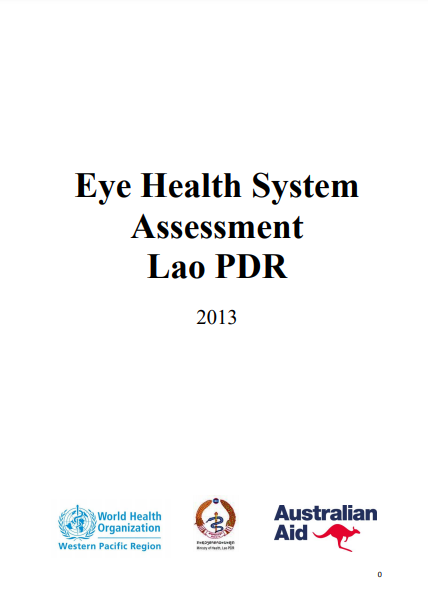
Eye Health System Assessment in Lao PDR

April 24, 2013

A recent survey in Lao PDR estimated that 3% of its population aged 50 years old and above is blind. This prevalence level is a bit higher than the blindness prevalence of Australia, which is under 1%. Primarily, blindness is caused by a cataract and low vision is caused by an uncorrected refractive error in LAO PDR. Besides the impact of vision loss on a person’s quality of life, there is also a substantial economic loss associated, including increased unemployment, decreased productivity and increased welfare cost.

In an effort to improve access to quality eye care services for all, including disadvantaged communities in Lao PDR, MoH with support from WHO and the International Centre for Eye Health at the London School of Hygiene and Tropical Medicine, conducted an Eye Health System Assessment (EHSA). The purpose of the exercise is to assess current systems and practices in place for the delivery of eye care at the primary level, including existing linkages between the eye health system, and the general health system. The findings of the in-depth analysis will lead to developing a set of country-specific recommendations.

Documents Download

Eye Health System Assessment in Lao PDR

Filed Under: Resources

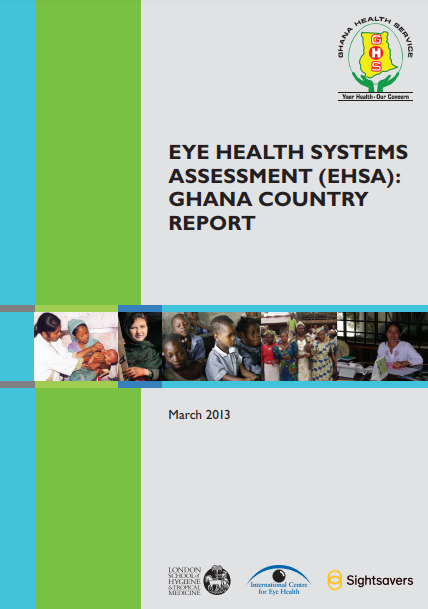
Eye Health System Assessment in Ghana

April 14, 2013

Over the last few years, increasing efforts have been invested in exploring the relationship between the eye health system and the general health system. Consensus is emerging in the international eye care community that the effectiveness of eye care interventions can only be improved through a better understanding of how health systems function.

A consortium of eye care experts and health experts, coordinated by the International Centre for Eye Health (ICEH) at the London School of Hygiene and Tropical Medicine (LSHTM), have therefore developed the Eye Health Assessment approach (EHSA), funded by Sightsavers.

Ghana was selected as the first country to pilot the EHSA, through discussion between the National Eye Care Unit (NECU) in Ghana, Sightsavers, and ICEH. This report documents assessment findings, providing a basis for strengthening the eye health system in Ghana and improving outcomes for eye conditions.

Documents Download

Ghana Eye Health System Assessment Report

Filed Under: Resources

  • « Go to Previous Page
  • Page 1
  • Interim pages omitted …
  • Page 66
  • Page 67
  • Page 68
  • Page 69
  • Page 70
  • Interim pages omitted …
  • Page 73
  • Go to Next Page »
  • Tej Kohli & Ruit Foundation
  • Tej Kohli
  • Contact
  • Our History
  • Eye Care
  • Giving
  • Contact


Copyright © 2026 . Tej Kohli Foundation All Rights Reserved