
• Skip to primary navigation
  • Skip to main content
  • Skip to footer
Tej Kohli Foundation

Tej Kohli Foundation

Rebuilding People And Communities

  • About
  • Our History
  • Eye Care
    • Tej Kohli & Ruit Foundation
    • Tej Kohli Applied Research
    • Tej Kohli Cornea Institute
    • Tej Kohli Cornea Program
  • Future Bionics
  • Giving
    • Funda Kohli
    • COVID-19 Response
  • News
  • Blog
  • Contact

Resources

OEU Kenya Kitale DR quantitative study report 2018

August 1, 2018

Diabetes is an emerging major cause of blindness in the world. In 2016, Kenya launched an ambitious project to screen all diabetic patients attended at referral hospitals for DR using retina cameras and treat those in need. Scientific data is needed to inform creation the hospital-based screening projects and this was the first study to provide such evidence. The study was conducted between March and April 2018 at diabetic medical clinic of Kitale level 5 Hospital in Trans-Nzoia County. It was funded by Seeing is Believing through the Operation Eyesight Universal. The objectives were to measure prevalence of DR in patients 18+ years old, assess accuracy of the made diagnosis using retina photographs, estimate prevalence of known risk factors and audit resources and services for DR.

This was a cross-sectional study approved by the Institutional Research and Ethics Committee of Moi University and management of Kitale hospital. Informed consent was taken followed by: visual acuity, dilatation of pupils, taking of retina photos by a validated technician, clinical examination by a validated eye doctor and review of patient`s files for risk factors. Retina photos were further assessed by a retina specialist. Audit of resources and services was done through interviews with hospital workers. Data was managed and analysed by an epidemiologist.

Documents Download

OEU Kenya Kitale DR quantitative study report 2018

Filed Under: Resources

Perkins SiB CHEER External evaluation 2018

August 1, 2018

Driven by the mission statement, “We’re Here for Good,” the Standard Chartered Bank helps people and businesses in Asia, Africa and the Middle East through a sight saving initiative called, “Seeing is Believing.” Four cities in Shanxi province in central China have benefited from Phase V of this support for the past five years through contributions of five partners: ORBIS International North Asia, based in Beijing China, Shanxi Province Eye Hospital, Brien Holden Vision Institute, Helen Keller International, and Perkins School for the Blind.

The final evaluation that follows is a summary, analysis and reflection of the contributions of Perkins through their Perkins International (PI) division.

Documents Download

Perkins SiB CHEER External evaluation 2018

Filed Under: Resources

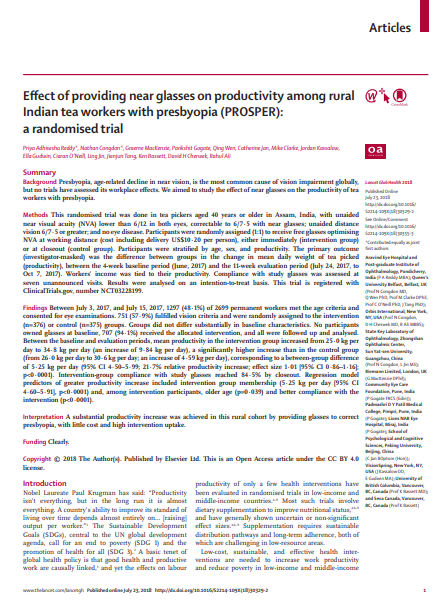
Effect of providing near glasses on productivity among rural Indian tea workers with presbyopia (PROSPER): a randomised trial

July 27, 2018


A trial of Indian tea pickers, has shown that the provision of glasses improved their productivity by 21.7 per cent – and for those aged over 50 the increase was 31.6 per cent. This represents the largest ever recorded productivity increase from any health intervention. The PROSPER [PROductivity Study of Presbyopia Elimination in Rural-dwellers] trial, is the first randomized controlled trial to show a link between good sight and work performance.

The findings were published in the Lancet Global Health .

The research was sponsored by Clearly, a global campaign to bring clear vision to the 2.5 billion people worldwide denied it as quickly as possible. It was carried out in collaboration with VisionSpring, a social enterprise dedicated to providing affordable glasses across the world, and Orbis, a global organization fighting avoidable blindness worldwide.

Documents Download

PROSPER RCT Study_Lancet-2018.07.23

Filed Under: Resources

A Situational Analysis: Eye Care Needs of Rohingya Refugees and the Affected Bangladeshi Host Population in Cox’s Bazar District Bangladesh

July 19, 2018

The Seva Foundation, recently released a new report to assess the eye care needs of the one million Rohingya people living in refugee camps in Bangladesh. “A Situational Analysis: Eye Care Needs of Rohingya Refugees and the Affected Bangladeshi Host Population in Cox’s Bazar District Bangladesh” provides a snapshot of the critical eye care needs in this region. Key international non-governmental organizations (INGOs) have established an eye care working group to coordinate sight-related medical response for these refugees. The report was completed in partnership with the International Agency for the Prevention of Blindness.

Documents Download

Rohingya Refugees Analysis Seva IAPB

Filed Under: Resources

Primary Eye Care Training Manual

July 3, 2018

The purpose of this manual released by the WHO Regional Office for Africa is to provide guidance in the design, implementation and evaluation of a course that aims to build and strengthen the capacity of health personnel to manage eye patients at primary-level health facilities in the African Region. The course falls within the remit of continuous professional development in its broadest sense. Its content focuses on simple evidence-based practice that can be easily carried out in primary-level health facilities all over Africa.

This manual is intended for use by course directors and facilitators. Its intended audience includes all persons who wish to commission, support or offer a course serving the above aims, including pre-service training. This manual sets out the requisite steps for the preparation and organization of such a course.

Documents Download

WHO Afro-Primary Eye Care training manual

Filed Under: Resources

Fred Hollows Foundation Bangladesh MTR

July 1, 2018

With deepest gratitude we wish to thank The Fred Hollows Foundation (FHF) Bangladesh to initiate this important study not only to evaluate but to know how to improve eye care facility among the marginalized people in Bangladesh. The Fred Hollows Foundation, through Standard Chartered Bank’s flagship project ‘Seeing is Believing’ (SiB) has implemented ‘Building Gender Equitable Eye Health Systems in Barisal Division’ project with the objective to bring down gender disparity in eye care, especially cataract services through health systems improvement approach.

Documents Download

Fred Hollows Foundation Bangladesh MTR

Filed Under: Resources

  • « Go to Previous Page
  • Page 1
  • Interim pages omitted …
  • Page 39
  • Page 40
  • Page 41
  • Page 42
  • Page 43
  • Interim pages omitted …
  • Page 73
  • Go to Next Page »
  • Tej Kohli & Ruit Foundation
  • Tej Kohli
  • Contact
  • Our History
  • Eye Care
  • Giving
  • Contact


Copyright © 2026 . Tej Kohli Foundation All Rights Reserved