• Skip to primary navigation
  • Skip to main content
  • Skip to footer
Tej Kohli Foundation

Tej Kohli Foundation

Rebuilding People And Communities

  • About
  • Our History
  • Eye Care
    • Tej Kohli & Ruit Foundation
    • Tej Kohli Applied Research
    • Tej Kohli Cornea Institute
    • Tej Kohli Cornea Program
  • Future Bionics
  • Giving
    • Funda Kohli
    • COVID-19 Response
  • News
  • Blog
  • Contact

Resources

Catalogue of key eye health indicators in the African region

October 17, 2019

To assess trends in the prevalence and causes of visual impairment, including blindness, to measure progress made by the Member States in preventing visual impairment, including blindness, and to monitor implementation of the Global Action Plan 2014-2019 for universal eye health, a set of core process and outcome indicators have been identified and defined as relevant for the African Region.

Documents Download

Catalogue of key eye health indicators in the African region
Original Source: iapb.org

Filed Under: Resources

Onchocerciasis Advocacy Document

October 11, 2019

A major cause of blindness and poverty – especially in Africa

Onchocerciasis/River Blindness

The data, statistics and narrative in this section are excerpted from the  © World Health Organization and Mectizan Donation Program websites

Onchocerciasis is caused by infection with the filarial parasite Onchocerca volvulus, which is transmitted by the blackfly species. It mainly affects communities living near rivers where the blackfly live and breed. The filarial worm is transmitted through the bites of infected black flies of the species Simulium. These flies carry the immature larval forms of the parasite and transmit them from human to human. In the human body, the larvae form nodules in the subcutaneous tissue, where they mature into adult worms. After mating, the female adult worm can release up to 1000 microfilariae a day. These move through the body, and when they die they cause a variety of conditions, including blindness, skin rashes, lesions, intense itching and skin depigmentation.

Onchocerciasis is endemic in 30 countries in Africa, Brazil, Venezuela and Yemen; the vast majority of the infected people live in West, Central and East Africa.

Currently, about 300 000 people are blind from onchocerciasis. Control measures entail larvicide spraying of blackfly breeding sites and treatment of endemic communities with the micro fi larvicide Mectizan® (ivermectin). Mectizan relieves the agonizing itching that accompanies the disease and halts progression toward blindness. Administered once annually, Mectizan is well suited for mass distribution in remote areas by community health workers. It is the only well-tolerated drug known to halt the development of river blindness.

In 1987 Merck announced the donation of Mectizan to all who needed it, for as long as needed and launched the Mectizan Donation Program (MDP) which is the longest-running, disease-specific, drug donation program and public/private partnership of its kind.  In 1998, Merck expanded the mandate of the program to include lymphatic filariasis elimination through the co-administration of Mectizan and albendazole, donated by GlaxoSmithKline, in African countries and Yemen where lymphatic filariasis and onchocerciasis are co-endemic.

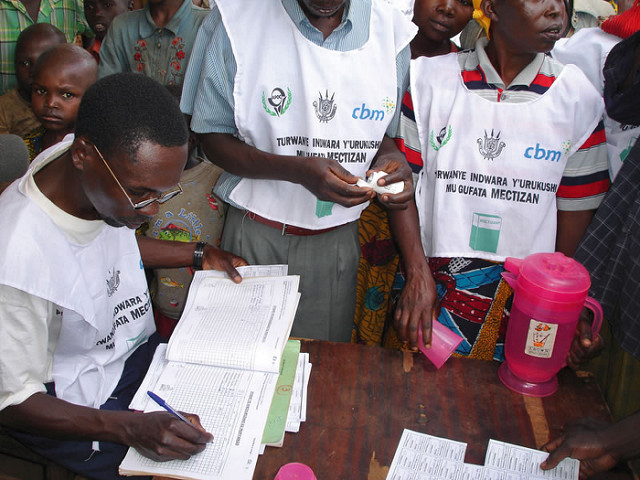
Measuring height to determine the correct dose. Between 1974 and 2002, onchocerciasis was brought under control in West Africa through the work of the Onchocerciasis Control Programme (OCP), using mainly the spray of insecticides against blackfly larvae (vector control) by helicopters and aeroplanes. This was supplemented by large-scale distribution of ivermectin since 1989. The OCP relieved 40 million people from infection, prevented blindness in 600 000 people, and ensured that 18 million children were born free from the threat of the disease and blindness. In addition, 25 million hectares of abandoned arable land were reclaimed for settlement and agricultural production, capable of feeding 17 million people annually.
Building on the success of the OCP, the African Programme for Onchocerciasis Control (APOC) was launched in 1995 to control onchocerciasis in the remaining endemic countries in Africa. Its main strategy has been the establishment of self-sustaining community-directed treatment with ivermectin, and, where appropriate, vector control with environmentally safe methods. APOC was a very successful African based partnership organization that includes 31 NTD endemic countries and communities, development partners, NGOs, foundations and the private sector for the last fifteen years. It supported the distribution of medicines in endemic countries by strengthening the health system by establishing a community-led health program that empowers communities to take charge of their health-related issues.

The programme was so successful that in 2009 APOC shifted from control to elimination of onchocerciasis in most countries of Africa by 2025.  With elimination defined as Reduction of O.volvulus infection and transmission to the extent that interventions can be stopped, but post-intervention surveillance is still necessary.

Recent successes have been the elimination of Onchocerciasis in Guatemala in 2016 – which is now the fourth country to eliminate Onchocerciasis, the others being, Mexico, Columbia, and Ecuador.

In 2015 the APOC ended and building on its success a new approach has been forged integrating the onchocerciasis control into the broader Neglected Tropical Diseases (NTD) agenda.  The Expanded Special Project for Elimination of Neglected Tropical Diseases (ESPEN)  project was launched at the WHO General Assembly in May 2016. It is hosted and managed by the World Health Organization (WHO) Regional Office for Africa (AFRO) and aims to reduce the burden of the five most prevalent neglected tropical diseases on the African continent. ESPEN will provide technical and fundraising support to endemic countries to help control and eliminate the five NTDs that are responsive to preventive chemotherapy. These diseases are lymphatic filariasis, trachoma, schistosomiasis, soil-transmitted helminthiasis and onchocerciasis. The project, which will run from 2016 to 2020, will help countries fill technical and financial gaps in national NTD projects and identify priority areas to tackle these diseases.

Links

  • World Health Organization – Information on Onchocerciasis
  • MDP Atlanta Anniversary Event: A Discussion with three visionaries – Jimmy Carter, Bill Foege, Roy Vagelos
  • http://www.mectizan.org/about
  • http://www.who.int/apoc/homepage/en/

Resources

  • http://www.who.int/apoc/publications/en/
  • http://www.mectizan.org/resources?type=Document

Photo credit: 
Recording Information by Adrian Hopkins
Measuring height to determine correct dose by Suzanne Porter/Sightsavers

Documents Download

Onchocerciasis Advocacy Document

Filed Under: Resources

IAPB Africa Bulletin Vol 8 No 2 2019

October 11, 2019

IAPB Africa Editorial: Making progress towards Universal Health Coverage

WHO has unveiled a landmark reform that targets primary care for billions of people. This “back-to-basics” targets one billion people in support of WHO’s top priority, Universal Health Coverage(UHC).  At the same time, a Resolution on Community Health Workers is to be considered at the upcoming World Health Assembly to accelerate progress on UHC and the Sustainable Development Goals (SDGs) health targets, recognizing the importance of community health workers as part of a diverse and sustainable health workforce skills mix.  “Promotive, preventive, curative, rehabilitative services and palliative care must be accessible to all – We can no longer underemphasize the crucial importance of health promotion and disease prevention, nor tolerate fragmented, unsafe or poor-quality care. We must address the shortage and uneven distribution of health workers”.

Meanwhile, Africa continues the march towards UHC ahead of the UN High-Level Meeting on UHC in September with Jean Kagubare, deputy director of Global Primary Health Care Systems at the Gates Foundation, stating “there is no better return on investment than strengthening primary health care.”

Closer to home, in eye health, the integration of an eye health component into primary health care (more commonly PEC into PHC) took a major step forward in March when WHO AFRO and IAPB Africa jointly launched the new Primary Eye Care Training Manual at a key event in Ghana. With 16 Anglophone countries represented, along with the IAPB team and many member agencies, the launch took forward the PEC agenda following the publication of WHO AFRO’s PEC Training Manual towards the end of last year.  The expectation now is that individual countries will build on this momentum and alignment and implement the recommendations of WHO and IAPB, moving PEC forward as part and parcel of the broader switch to primary health care in pursuit of Universal eye Health Coverage (UeHC).

Finally, in February, IAPB Africa held its annual planning meeting in Accra where the secretariat, members and partner organizations developed a draft implementation plan to tackle key issues facing eye health in Africa.  The plan will outline the roles to be undertaken by both the secretariat and members during the period 2019-2021.

Image: Two eye health workers are taking the visual acuity of two patients at the same time/ Image Credit: Francisco Sanz for #MakeVisionCount

Documents Download

IAPB Africa Bulletin Vol 8 No 2 2019

Filed Under: Resources

The Missing Billion

October 11, 2019

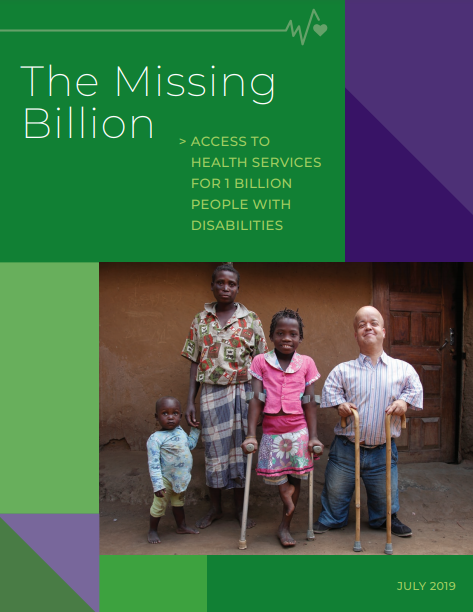
One billion people around the world live with disabilities. This report makes the case that they are being “left behind” in the global community’s work on health. This lack of access not only violates the rights of people with disabilities under international law, but Universal Health Coverage and Sustainable Development Goal 3 cannot be attained without better health services for the one billion people with disabilities.

Read more here

Documents Download

The Missing Billion

Filed Under: Resources

The World Report on Vision IAPB summary

October 8, 2019

Our modern world is built on our ability to see. Without vision, many of us would struggle to learn, to read, to participate in school, find work and to live life to the fullest. Today, at least 2.2 billion people have a vision impairment and of these, at least 1 billion have a vision impairment that could have been prevented or is yet to be addressed.

This is a summary from IAPB outlining the key points from the World Report on Vision.

Documents Download

World Report on Vision IAPB Summary

Filed Under: Resources

IAPB WHO World Report on Vision Launch Pack

October 8, 2019

This document provides IAPB’s key messages on the World Report on Vision, including the key findings and recommendations of report, IAPB’s press release and a social media and communications toolkit.

The World Report on Vision seeks to generate greater awareness and increased political will and investment to strengthen eye care globally. The report sets out concrete proposals to address sigificant challenges in delivering eye care. Its key proposal is to integrate and scale up ‘people-centred eye care’, embedded in health systems and based on strong primary health care.

Peter Holland, CEO, IAPB: “It is unacceptable that more than a billion people are affected by treatable or avoidable sight loss. And this number is projected to balloon in the coming years—we need to act now. I congratulate the WHO and partners for launching this crucial document on the eve of World Sight Day. In the coming months, we will work with the WHO and IAPB member organisations to advocate for and deliver the World Report’s priorities across the world”.

Documents Download

IAPB World Report on Vision Launch Pack

Filed Under: Resources

  • « Go to Previous Page
  • Page 1
  • Interim pages omitted …
  • Page 32
  • Page 33
  • Page 34
  • Page 35
  • Page 36
  • Interim pages omitted …
  • Page 73
  • Go to Next Page »
  • Tej Kohli & Ruit Foundation
  • Tej Kohli
  • Contact
  • Our History
  • Eye Care
  • Giving
  • Contact


Copyright © 2026 . Tej Kohli Foundation All Rights Reserved